How Moveworks used Rocketlane's timesheet governance agent to cut manual approvals by 2 to 3 Hours
.webp)
Region
US
Industry
Conversational AI
Use case
Time-Tracking, Project Governance , Project Management
Before
- PTO logged as admin time went undetected until month-end, skewing utilization data and triggering manual investigation every cycle.
- Utilization issues only surfaced during end-of-month reviews, too late to course correct before reporting to executive leadership.
- 2–3 hours spent every month manually running reports, digging into anomalies, and cleaning miscategorized time entries.
After
- The Timesheet Governance Agent catches PTO miscategorization at the point of entry, eliminating the end-of-month investigation entirely.
- Utilization alerts now surface within the same week, giving managers time to understand and fix issues before the reporting cycle closes.
- 2–3 hours saved every month as the agent handles the first-pass analysis automatically, freeing Kristen for higher-priority work.
About Moveworks
When Kristen Rosenberry joined Moveworks as a Senior Professional Services Operations and Strategy Manager, she walked into a fast-scaling global PS organization that was still running on manual processes.
Moveworks, a leading enterprise AI company recently acquired by ServiceNow, supports over 5 million users globally, and their PS team was growing to match that scale. But the time tracking, approval, and utilization processes had not kept up. Kristen knew that before she could drive margin targets and utilization goals, she needed to fix the foundation first.
The Challenge
No structured approval process to speak of
When Kristen joined, Moveworks was not consistently using the timesheet approval functionality. There was no structured process for managers to review time entries, which meant errors and anomalies were going unnoticed week over week. Getting managers to actually use approvals, and to know what to look for when they did, was the first hurdle.
No visibility into who was trending below or above target
With a global team of implementation managers and forward deployed engineers, each with different billable utilization targets, the only way to know who was falling short or overworking was at the end of the month during books balancing, by which point it was too late to course correct.
PTO logged as admin time was skewing utilization data
With a flex PTO policy and global holiday schedules, team members were logging time off as admin time against the internal project instead of using Rocketlane's native time off functionality. The result was inflated admin hours and deflated billable utilization, discovered only at month end.
Miscategorized time entries creating downstream confusion
Time was ending up in the wrong buckets, whether due to work patterns, template errors, or entries being recategorized at the point of logging. Figuring out whether time was actually billable or not, and where it should have gone, required manual investigation after the fact.
The Solution
Three Governance Policies, each tied to a business outcome
Kristen set up three policies using Rocketlane's Timesheet Governance Agent, an AI agent that lets you describe your team's rules in plain English and automatically enforces them in real time as people log time.
Instead of manually running reports and chasing down errors every week, the agent does that first pass automatically, and managers only see what needs their attention.
Kristen took a deliberate approach, anchoring each policy to a specific business goal rather than just fixing a process problem.
- Block PTO and OOO time from being logged in the internal time tracking project
The goal was to ensure the team used Rocketlane's native time off functionality so that capacity data stayed accurate and billable utilization numbers were not skewed by PTO being miscategorized as admin time.
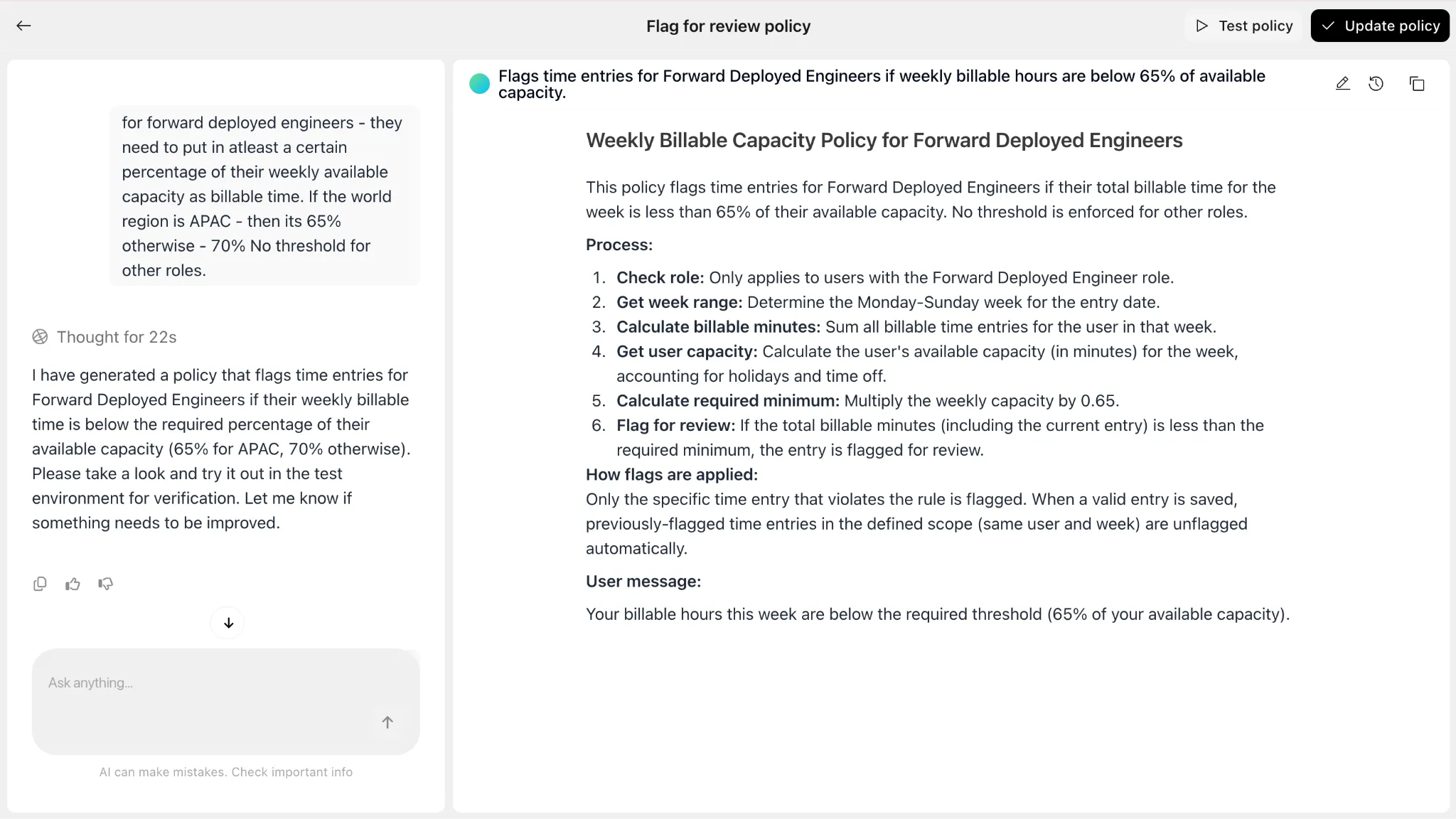
- Flag when Implementation Managers fall below 80% billable utilization and Forward Deployed Engineers fall below 65% to 70% depending on region
Rather than a hard block, this was set up as a soft flag so team members could still submit their timesheets. But managers reviewing approvals could now immediately see who was trending below their utilization target and why, giving them a chance to address it in the same week rather than weeks later.
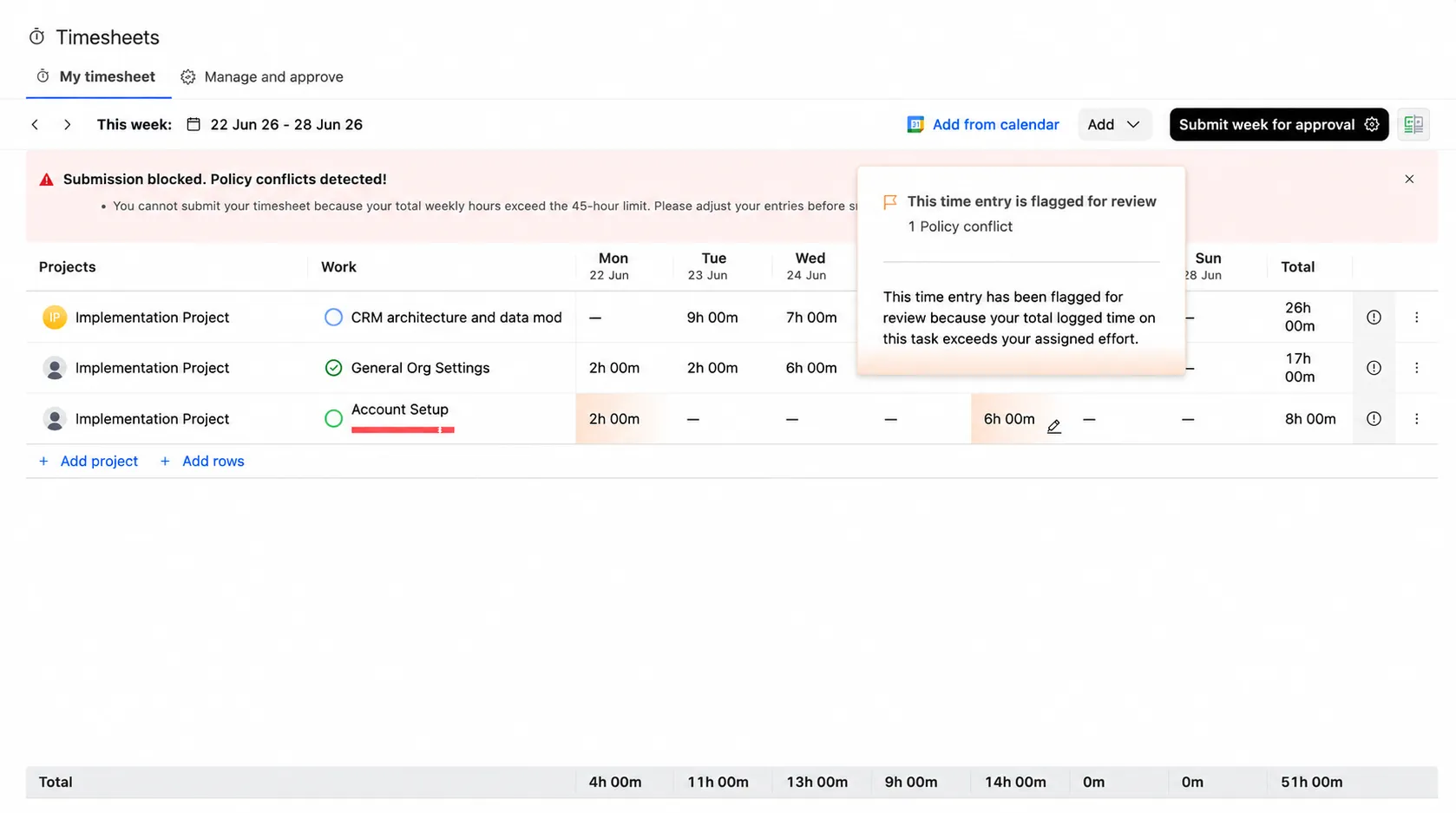
- Flag only the time entry that causes a user's weekly total to cross 50 hours
This was set up as both a burnout risk signal and an error catch. Consistently working over 40 hours is a data point that should inform headcount decisions and workload balancing. It also catches accidental entry errors, like someone logging 14 hours instead of 4 on a single task.
The Impact
PTO miscategorization caught before it distorts the numbers
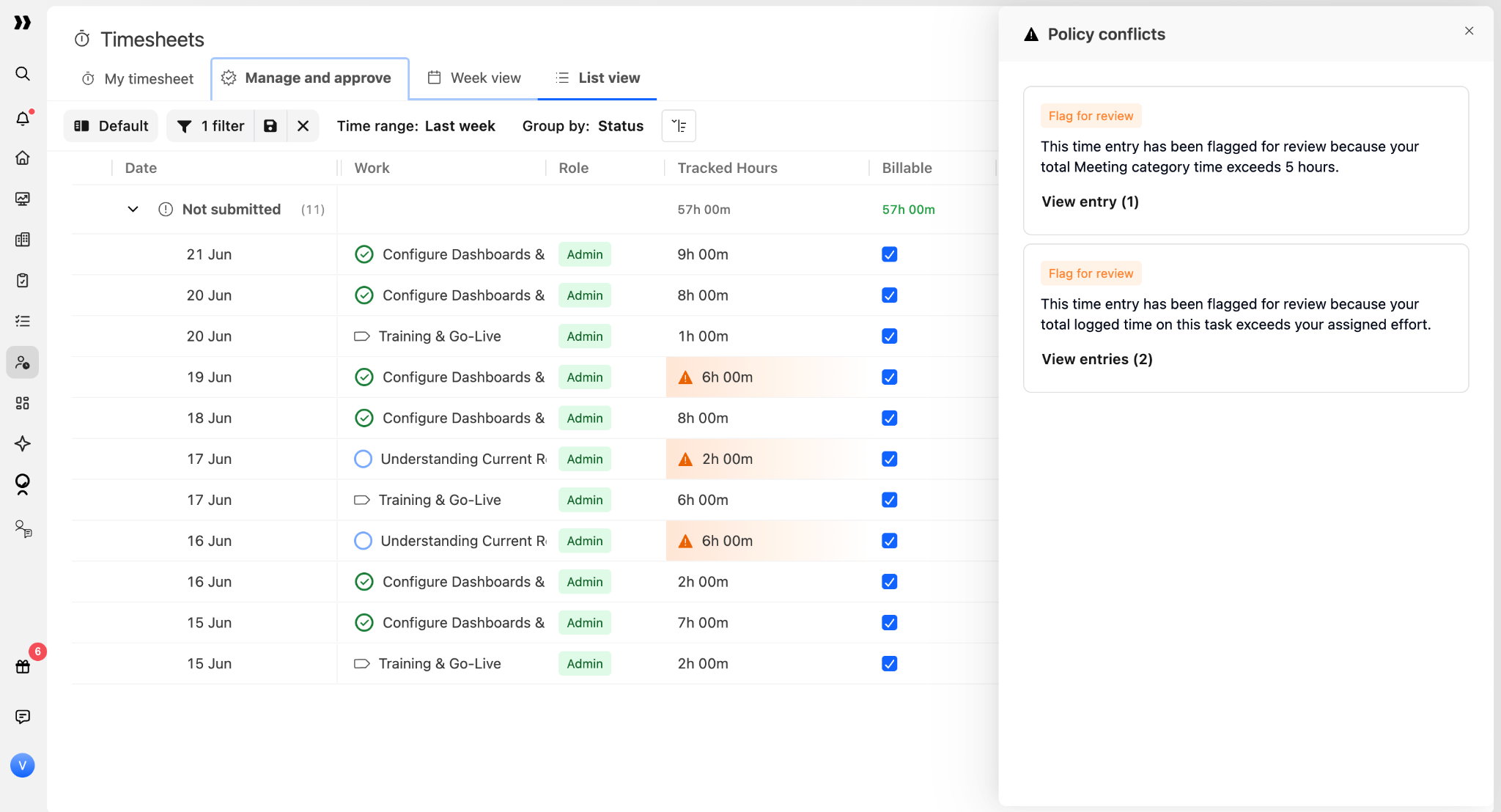
The PTO policy has been live for a couple of months and the impact was immediate. The agent catches PTO being logged as admin time at the point of entry, eliminating the end of month investigation entirely.
"Instead of me having to go in and run a full time tracking report, dig into why admin time is so high or why the utilization looks off, I don't have to do that anymore."
2 to 3 hours saved every month on manual analysis
Just the PTO policy alone has saved Kristen 2 to 3 hours a month in manual analysis time. Having the governance agent catch it at the source eliminated the time spent prompting, cleaning data, and verifying outputs manually.
From end of month lookbacks to same week course correction
Before the Timesheet Governance Agent, Kristen was doing historical reviews at the end of the month. By the time a utilization issue surfaced, it was already too late to fix it before reporting to executive leadership. Now the agent surfaces alerts within the same week, giving managers the chance to understand where time went and adjust before the cycle closes.
"It's still reactive, but it's reactive in the same week, not several weeks later when I'm having to report out to our executive leadership team that we missed our billable utilization target for the month. If I can rectify the why earlier in the cycle, that helps everybody win."
A smarter path to hitting margin neutrality targets
For Kristen, the larger goal is cost neutrality across the PS organization. Weekly visibility into utilization by role, accurate capacity data, and early burnout signals are all inputs into that goal. The Timesheet Governance Agent has made those inputs reliable and timely for the first time.
Want the full story?
Access detailed strategies, outcomes, and best practices in our customer spotlight playbook.


Fintech/Financial Services
How Xceptor streamlined global client delivery and improved financial control with Rocketlane


Professional Services & Consulting