Region
US
Industry
Fintech/Financial Services
Use case
Time-tracking, Project Governance
Results
Concurrent projects governed
Results
To configure and validate timesheet policy
Clutch is a Series B fintech startup running approximately 100 concurrent implementation projects at any given time, with a team of around 30 consultants, 12 project managers, and 16 implementation engineers, all tracking time weekly against project-level forecasts. The organization generates hundreds of individual time card line items every week. Daniel Levine, Director of Professional Services, recognized that manual processes would not sustain growth and that system-level rule enforcement was necessary.
Manual time card reconciliation at scale
Comparing actuals against forecasts required opening individual time cards and manually reconciling hours with forecasts. There was no aggregated portfolio view.
"If you wanted to see whose time significantly exceeded what they were forecasted for a given project, you had to dig into somebody's individual time card" — Daniel Levine, Director of Professional Services, Clutch
Limited operations capacity
Clutch's hourly operations contractor devoted significant weekly capacity to manual time card audits. This necessary work consumed hours that could otherwise support process improvement, enablement, and operational advancement.
Reactive rather than proactive oversight
Without automated flagging systems, managers lacked early signals for burnout or forecast divergence. By the time anyone identified issues through manual review, intervention opportunities had closed.
Leadership reporting barriers
Extracting meaningful insights required someone to pull data and prepare reports first. This dependency meant consistent reporting never materialized at the leadership level.
A real-time governance agent
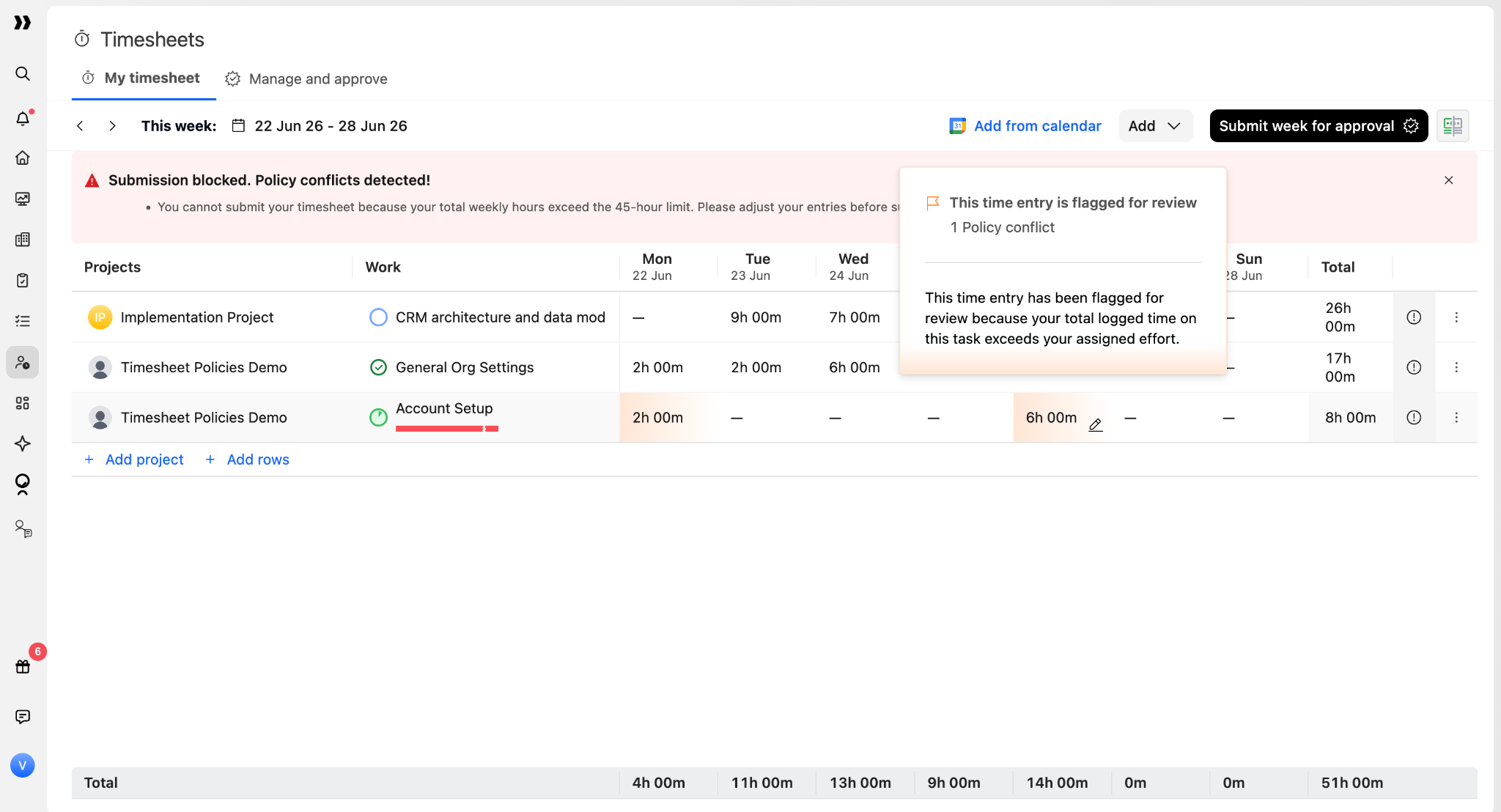
Rocketlane's Timesheet Governance Agent enforces plain-language rules automatically across all time entries as consultants submit work. Rather than manual audits, the system flags exceptions automatically, allowing managers to focus only on entries requiring action.
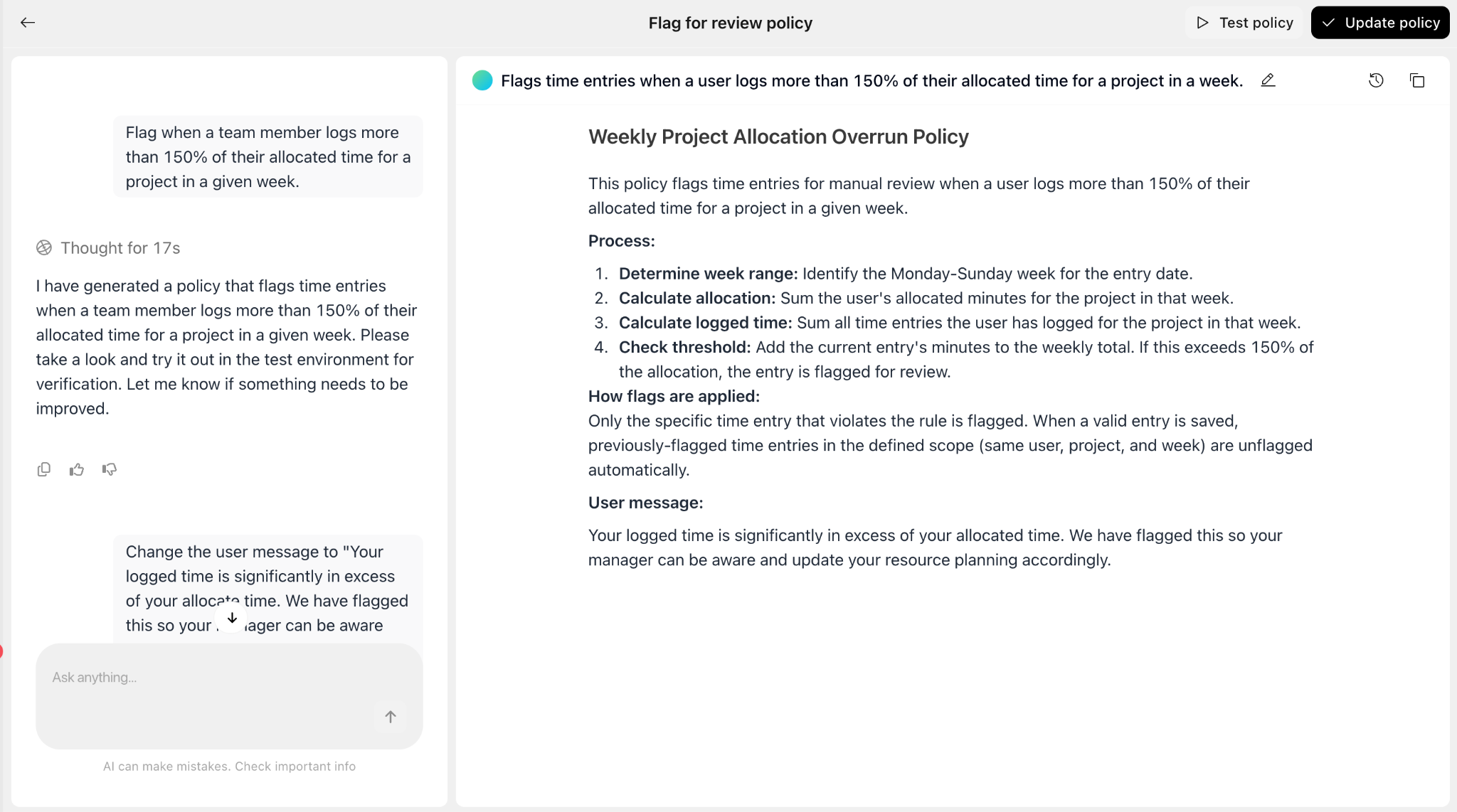
Daniel configured an automatic flag for consultants logging more than 150% of allocated hours weekly on any project. The rule deployed in plain English text with no formulas or configuration forms — three minutes from rule entry to validated policy. Time entries submitted to wrong categories or project phases are stopped at submission point, with consultants directed to correct entries before approval. Over-utilisation triggers manager notifications without blocking consultant submissions, and consultants receive in-product acknowledgment that leadership has seen their workload.
"I knew what this needs to look like in a mature state. I immediately saw how the Timesheet Governance Agent would accelerate us getting there."
"Literally three minutes to create a rule, test it, it worked the first time. The process could not have been smoother." — Daniel Levine, Director of Professional Services, Clutch
Automated exception detection
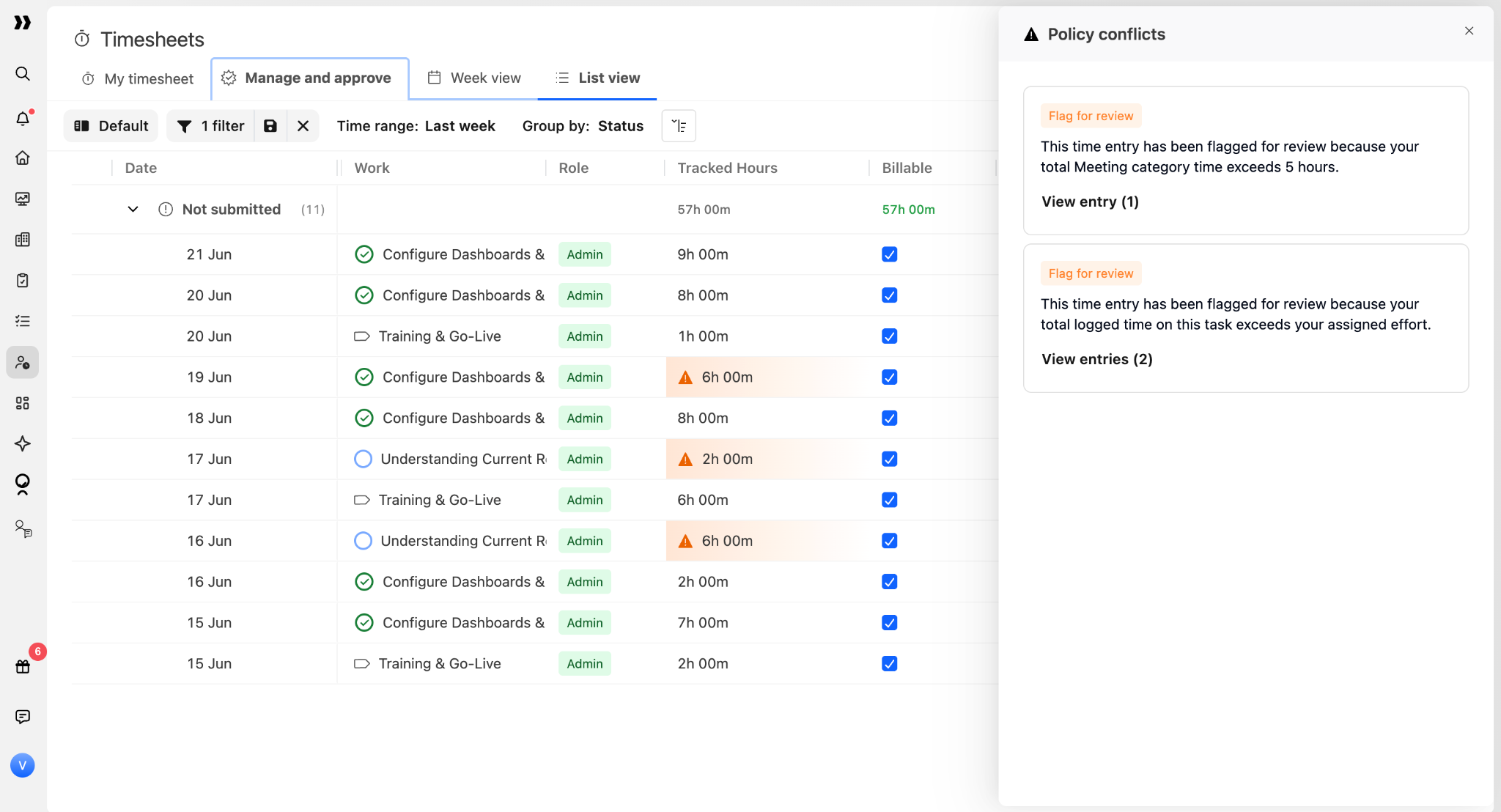
The Governance Agent scans hundreds of weekly time card entries across all 100 concurrent projects simultaneously against all active rules. Only entries requiring attention appear in the approvals view, reducing review time from hours to minutes.
Operations team reallocation
Freed from routine audits, the operations contractor redirects capacity toward process improvement, enablement, and policy development — work that compounds organizational value over time.
Point-of-entry error prevention
Miscategorised entries cannot reach forecasts, project allocations, or leadership reports. Corrections happen at submission rather than surfacing later as discrepancies requiring untangling.
Forecasting infrastructure
As Clutch transitioned toward continuous forecast tracking rather than monthly updates, the Governance Agent provided the enforcement layer making more frequent forecasting viable. Without automated actuals comparison, increased forecasting would generate unmanageable manual review volume.
"There's more important work to be done than manually sifting through time card entries every week."
"It's super easy to set up. You already know the types of things you want to flag and take action on. And to have a system go through hundreds of line items, prevent things from being entered the wrong way, and flag exactly where you need to take action, it's a huge efficiency gain." — Daniel Levine, Director of Professional Services, Clutch
Access detailed strategies, outcomes, and best practices in our customer spotlight playbook.
SaaS

How Graphite reduced onboarding time by 90%, implementing a $30K client in just 26 hours
Lorem ipsum dolor sit amet, consectetur adipiscing elit. Suspendisse varius enim in eros elementum tristique. Duis cursus, mi quis viverra ornare, eros dolor interdum nulla, ut commodo diam libero vitae erat. Aenean faucibus nibh et justo cursus id rutrum lorem imperdiet. Nunc ut sem vitae risus tristique posuere.
Read more
IT services
.webp)
How nCloud Integrators saves 2,000+ hours in repetitive tasks while managing 400+ projects
Lorem ipsum dolor sit amet, consectetur adipiscing elit. Suspendisse varius enim in eros elementum tristique. Duis cursus, mi quis viverra ornare, eros dolor interdum nulla, ut commodo diam libero vitae erat. Aenean faucibus nibh et justo cursus id rutrum lorem imperdiet. Nunc ut sem vitae risus tristique posuere.
Read more
Fintech/Financial Services
.webp)
How GoCardless scaled professional services to deliver 59% faster time-to-value
Lorem ipsum dolor sit amet, consectetur adipiscing elit. Suspendisse varius enim in eros elementum tristique. Duis cursus, mi quis viverra ornare, eros dolor interdum nulla, ut commodo diam libero vitae erat. Aenean faucibus nibh et justo cursus id rutrum lorem imperdiet. Nunc ut sem vitae risus tristique posuere.
Read more













Copyright © 2025 Rocketlane Corp. All rights reserved.